Friday, 16 June 2017

I had Kidney Failure, this is my story


I am fortunate enough to be a member of the kidney transplant club. This process isn’t as simple as getting sliced open, sewn up, and you’re good to go. No such luck. Thanks to modern medicine I was able to get off of dialysis. Also of course, thanks to my awesome wife who donated the organ.

How did i get here?

I inherited a kidney disease from my mother. The doctor assured me that it wasn’t a problem as long as I take care of myself. However, being young and irresponsible, I wasn’t exactly cautious about my health. In my 20’s I unknowingly developed gout. I saw a doctor but the gout was misdiagnosed as tendinitis, so I was unable to treat it properly. High blood pressure problems plagued me as well, but I mostly shrugged them off.

The day my kidneys shut down

Being the fun loving youth that I was, I had decided to attend a party. While at my friend’s house I started to feel unwell, my chest was pounding and I felt pretty weak. I thought maybe I’d had one too many. The next day breathing was a bit difficult and weakness persisted. This went on with increasing intensity until Wednesday of that week, about three days. I’d had very little food, couldn’t breathe, and was beginning to black out. I was taken to the hospital and told that I looked a bit pale. Once my blood pressure was checked however, it was determined that I was in stroke territory.
Hospital

Once I was wheeled into the ER, I was told that my kidneys had failed, and my blood pressure was dangerously high. Apparently my kidneys had been failing all week and they decided to crash that day. It took about 20 hours to get my blood pressure under control, and I was notified that I needed to go on dialysis. I was also told to quit smoking that day or I wouldn’t live much longer at all.
My whole life changed that day. My nutrition was strictly monitored. I was put on a renal diet, which is basically eating with salt, potassium, calcium, and phosphorous restrictions and taking some 40 pills a day to manage my blood pressure and electrolytes, among other things. I am fortunate to have had an amazing medical staff. Without them, I shudder to imagine how things could have turned out.

What is Dialysis?

Dialysis is the clinical purification of blood by filtration, as a substitute for the normal function of the kidney. It means that a machine helps to filter your body’s waste products. There are two methods. Peritoneal, which involves filtration through the peritoneum in the abdomen. Or Hemodialysis, filtration of blood through a large machine. It sucks but it keeps you among the living.

Me and my Dialysis machine become bros
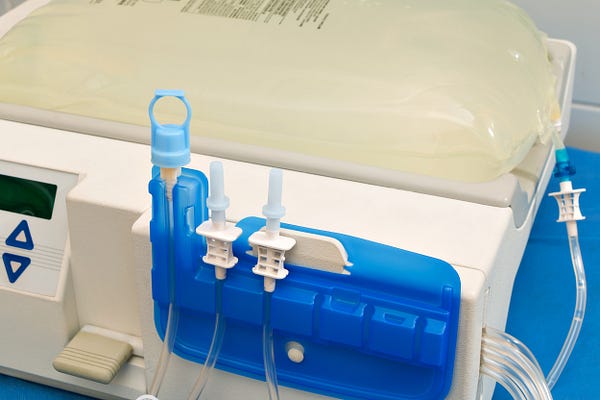
I had the option of picking what kind of dialysis I wanted. I chose Peritoneal Dialysis, a procedure in which a tube is placed in my peritoneal cavity to carry fluids to and from my body. The surgery was about an hour. My particular treatment restricted my fluids, allowing me only 1 liter of liquid per day. My treatment lasted for about 9 hours a night, everyday. It takes about an entire wall’s worth of supplies, around 30 boxes of fluid that weigh 25 lbs each, and two boxes of regular supplies. My machine, referred to as a cycler, hums like a loud AC all night. Some funny smelling liquid goes inside of me, dwells within for a while and comes back out looking like pee. Dialysis alone isn’t enough to protect the kidney, nutrition is still a huge factor in my well being. The treatment itself was difficult for me. My chest felt too full and acid reflux was a murderous, hateful thing to go through. Sleep was next to impossible due to feeling so full. Trying to keep my catheter from tangling was also a hassle. So my wife and I decided to explore other options.

The search for a transplant donor

The process leading up to being listed for transplant can be complicated. First, you have to be healthy enough for the surgery itself. This means arriving at the target Body Mass Index (BMI) of 18–22. As well as having your blood pressure under control. Second, you must not smoke tobacco, or take illegal drugs, do so and you will be taken off the transplant list. Third, you must have below 20% remaining kidney function and be displaying symptoms of toxicity. The final and, in my opinion, most frustrating step, is a financial and mental evaluation. The financial evaluation determines if you can afford medication. If you cannot take care of a precious organ, you will not be placed on the list. The mental evaluation is to make sure you are of stable mind and mood and are willing to continue living.
These steps, once met, only get you listed. The wait for a donor, depending on where you get listed, can be anywhere from 4 to 8 years. I chose University of California Davis. Although it’s not uncommon to wait much longer than that. To determine a donor’s compatibility for a transplantation, a simple blood and urine test is administered. Luckily for me, my wife was compatible, and we were able to schedule our surgery in about three months. The donor is under the same perquisites as the recipient, and has to be healthy enough to donate as well. Donating a kidney does not diminish or harm the donor in any way. A fact I was quite thankful to find out, because I was afraid of risking my wife’s health.
There is also something called the Final Directive. There is a meeting that my wife and I had to have with a counselor in which we discussed my wishes for worst case scenarios. The risks for surgery were discussed at length. I also had to designate a caretaker for both of us. All of this goes into a document that the hospital was required to have a copy of on file.

Transplant

Any major surgery carries risk, and this is no exception. The procedure for the donor is about 4 hours long and is done about an hour before the recipient goes under. The recipient’s procedure is 3–5 hours, and the new kidney goes in the pelvis. A strange place, but it’s easier and safer than replacing the old kidneys.
A common misconception is that transplant is a cure. This is not so. Transplant is another type of treatment, albeit the most preferable, since it comes with the highest quality of life. Also, transplant is not permanent. There is the risk of rejection, infection, and medication conflicts. The first three months after transplant are just as challenging as some of my hardest days on dialysis.
For the first three months I had to be in a nearly sterile environment. I had to wear a face mask for 24 hours everyday and eliminated outside contact. I could not be around anyone who was sick because I would catch whatever they had, and risk damaging the new kidney. Raw meats and unwashed veggies are out, so no more delicious rare steak, no more sushi. Unwashed foods can carry bacteria that could make me sick. The medication side effects are also strongest in this time, and trust me when I say that transplant meds are some intense stuff. Hallucinations, tremors, fevers, flushing and my stomach was upset for most of the first 60 days. Also, recovering from major surgery to the abdomen is hell. Can’t cough, laugh, or turn, and sneezing is a nightmare. I never knew how important abdominal muscles were until this experience. Needless to say I will never make fun of anyone with a hernia again.
We even had to make a rotating schedule between my family and closest friends, my wife and I needed round the clock care during our recovery. My weekly appointments also became a three hour quest because I could not drive myself. Some poor soul had to do it for me. I am eternally grateful for the help, but I’m glad it’s over.

How I feel today

After 4–5 months, I was able to move my midsection. I acclimated to the medications, and my energy level rose. My appetite returned, and I started to feel like a human being again. Recovery time for my wife was a whopping 40 days. She was back to work and lecturing me about my food in no time. After I was sufficiently healthy to be on my own, I began to volunteer at my local Kaiser Permanente as a guest speaker on dialysis. I shared my experiences with the patients. I also answered any questions for people who were considering their dialysis options.
My disease problems are far from solved. I will always have to be prepared to be back on dialysis and I’ll definitely never be a cage fighter. There are many things I can no longer do, namely sports. But thankfully, this has bought me at least 10 years of time to eat some normal food, travel with my wife and dear friends, and accomplish as many goals as I want. It’s not a cure, but it damn sure beats not having any choices at all.

Tuesday, 13 June 2017

Why Some Schools Want Students to Eat Breakfast in Class

Students do better when they’ve been fed. And sharing a meal ends the free-food stigma, while giving kids a chance to practice teamwork.

Grace Santos and Sidney Fletcher eat breakfast in their third-grade class at Dr. Martin Luther King Jr. School #11 in Jersey City, N.J. Photographs by Amy Newman for Bright
The third-graders of Room 105A were ready for their morning routine. Just before the 8:30 a.m. bell, they lined up with their teacher outside P.S. 11 in Jersey City, N.J., all chatter and fidgets and giggles as they waited for the first bell to ring.
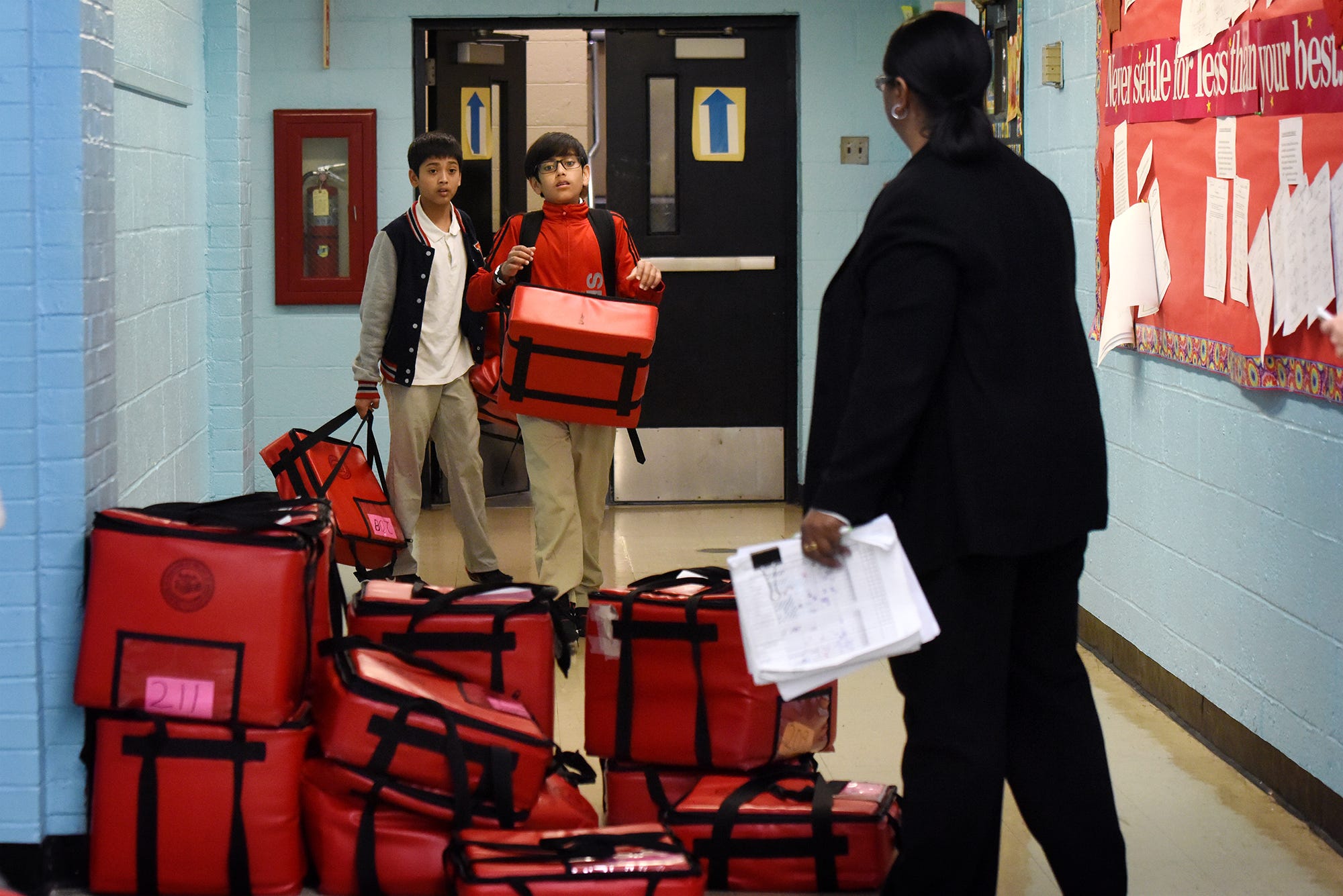
Brrrrring! In neat rows of two, they walked down the hall and into the classroom, hung up their backpacks, and took their seats. Three students at the front of the room unzipped insulated red bags that had been delivered moments before. They circulated throughout the class of 25, carefully placing a cold orange juice container and warm plastic bag with the day’s free, in-school breakfast on each desk.
And just like that, a regular Tuesday was transformed into Pancake Day — pretty much everyone’s favorite.
“I really like this breakfast,” said Elisa Tadros, 9, who was savoring her maple-flavored, whole-wheat miniature pancakes. “It tastes really good.” Her seatmate Ramia Fawzy, 10, had already finished her meal and was moving on to the morning’s second activity: logging onto her laptop to access a literacy skills app.
This innovative approach to school-based nutrition is called “breakfast after the bell” — a strategy as straightforward as its name. Instead of asking students to show up early and come to the cafeteria to eat, schools like P.S. 11 deliver breakfast to students right at the start of the school day.
The practice significantly boosts the number of students who fuel up at school: in typical before-school cafeteria programs, only 53 percent of eligible students eat breakfast, on average. Schools that serve breakfast after the bell report major gains, with 80 percent or more of students taking part.
Educators say it is not only convenient, but also minimizes the potential stigma of arriving early for a separate program for low-income students. And the simple act of sharing a meal is itself a learning experience, a chance for students to practice teamwork, responsibility and serving others.
Tamoor Faisal and Kush Patel, eighth-grade students at Dr. Martin Luther King, Jr. P.S.#11 in Jersey City, help deliver breakfast to fellow students with help from Assistant Principal Mary K. Truesdale. Breakfast is packed into cooler bags in the cafeteria and delivered to individual classrooms.
“It just has so many positive effects,” said P.S. 11 Principal Cleopatra Wingard. “Students used to visit the nurse throughout the morning for food. We don’t see that anymore. They serve one another and see the importance of a balanced meal. And it also helps get kids here on time — they are often running up the stairs in the morning, just to make sure they don’t miss breakfast.”

American schools have served breakfast to low-income students since the 1960s, as an offshoot of the National School Lunch Program. The programs take on the stubborn shame of childhood hunger in the United States: some 6.4 million children live in homes that do not reliably have enough food on the table, about one in five U.S. households, according to federal data from 2015.
The country is on track to serve 12.4 million free and reduced-price school breakfasts this school year, to students who qualify under family income eligibility guidelines set by the U.S. Department of Agriculture’s Food and Nutrition Service. It’s a record high.
The number of subsidized breakfasts has grown by about 50 percent in the past decade, from 7.9 million meals in 2006.
States and school districts administer the program and receive cash subsidies from the federal government to help pay for the meals, which cost around $1.75 each. USDA subsidies for the School Breakfast Program will top $4.2 billion in 2016–2017 — a considerable investment, but far less than for the National School Lunch Program, which is on track to top $13.6 billion in subsidies and provides 22 million free and reduced-price lunches nationwide.
In addition to providing subsidies, the federal government also regulates what can and cannot go on students’ meal trays. It is an arrangement prone to gaffes and political fistfights, especially when you throw finicky kids and regional food traditions into the mix. The most modern iteration dates back to a Reagan-era proposal that characterized ketchup (and fries) as a vegetable, stretches across the childhood obesity explosion of the 1990s and early 2000s, and reaches former first lady Michelle Obama, who advocated for stricter school nutrition standards and health initiatives under her “Let’s Move” campaign.
One result was the bipartisan 2010 Healthy Hunger-Free Kids Act, which required fresh fruit and vegetables, whole grains and other changes to students’ lunch trays. The regulations were widely criticized by state leaders and GOP members of Congress for being overly restrictive and forcing schools to serve food that students would not eat, and lawmakers have since introduced several bills to either soften or repeal the law, without result. A series of studies examined student eating habits in Seattle, Texas, Connecticut and Massachusetts and found children made healthier food choices — such as eating more fresh fruit — after the standards were implemented in cafeterias starting in 2012.
Rolling back the nutrition rules was a stated goal of President Trump’s campaign, and in May 2017, his appointee at the U.S. Department of Agriculture, Secretary Sonny Perdue, issued a proclamation doing just that. It allows schools to serve children flavored milk, and food with more sodium than the original rules allowed. States also can be granted exemptions from serving only whole grains in coming years, which the law requires.
“If kids aren’t eating the food, and it’s ending up in the trash, they aren’t getting any nutrition — thus undermining the intent of the program,” Perdue said, lauding the return of decision-making authority to local school districts instead of the federal government.

Can subsidized school breakfast continue to grow in the current political climate? While the Trump Administration’s budget proposal targets a host of anti-poverty initiatives for deep cuts in spending, funding school meals is not among them.
Other sources of nutrition support for low-income students are slated for steep reductions, however, such a proposed 25 percent cut to food stamps under the Supplemental Nutrition Assistant Program (SNAP) and the elimination of all $1.2 billion in federal funding for 21st Century Community Learning Centers, which support after-school enrichment programs that include snacks and meals. Administration officials have said that, while the programs are supposed to feed children and help them at school, they are ineffective. However, a 2013–2014 U.S. Department of Education study reported that between one-third and half of participating students earned better grades in math and English and improved their homework and in-class participation.
Outside of the budget process, a key provision in the school-nutrition law that has fueled the growth of breakfast participation may be headed for reform by Congress: the Community Eligibility Provision. Under that rule, schools or districts where more than 40 percent of families receive direct assistance, such as food stamps or welfare benefits, can receive extra subsidies to make breakfast universal by offering free in-school meals to all students, whether or not they meet income eligibility guidelines. In Jersey City, for example, every school provides breakfast to all students, even though only about 70 percent of families qualify for free or reduced-price school meals, said Barbarito Ramos, acting food service director.
Advocates support universal school meals because it cuts down on paperwork, minimizes stigma and boosts participation. But some conservatives, particularly Republicans in the U.S. House of Representatives, have criticized the practice for unfairly subsidizing meals for families who are able to pay. In past sessions, GOP representatives have proposed reforms such as raising the threshold to 60 percent, an idea poised to take root.

0utside the beltway, state and local leaders have moved aggressively over the past decade to expand school-breakfast participation by instituting “breakfast after the bell.”
Lawmakers in 10 states, plus the District of Columbia, have mandated or funded breakfast after the bell: Arkansas, Colorado, Delaware, Illinois, Maryland, Nevada, New Mexico, Texas, Virginia and West Virginia. The practice is officially “recommended” by state law in New Jersey, home to P.S. 11. And bills mandating the practice are circulating in statehouses in Maine, Massachusetts and Washington. Several state education departments have used regulation to promote the practice, including by specifying that minutes spent on in-class meals can count toward required instructional time.
Schools that shift breakfast programs to the classroom report enormous growth.
For example, at Parker Middle School in the Taunton district in southern Massachusetts, student breakfast participation grew from 26 percent to 95 percent after it was offered during the school day, according to Children’s Healthwatch. School officials reported that the number of nurse visits dropped by 24 percent, which they estimated boosted on-task learning time by 18,000 minutes overall.
Big-city districts such as Chicago and Houston have doubled school breakfast participation by moving breakfast out of the cafeteria and after the bell, according to the No Kid Hungry Center for Best Practices campaign. In Houston, where 80 percent of students qualify for free or reduced-price school meals, just 30 percent were eating school breakfast when it was offered before the start of the day. After a successful 2009 pilot involving 30 schools, it was expanded to all elementary and middle schools in 2010, and the number of students eating breakfast doubled. Two years later, nearly four out of five students eating school lunches also ate school breakfast.
The programs look different depending on the age of the students, with most high schools swapping out meal delivery for “grab and go” kiosks in the hallway, so fast-moving teenagers can pick up a meal to bring to homeroom. Keeping track of it all, not to mention keeping classrooms clean, can be daunting to some principals, teachers, food-service workers and custodians.
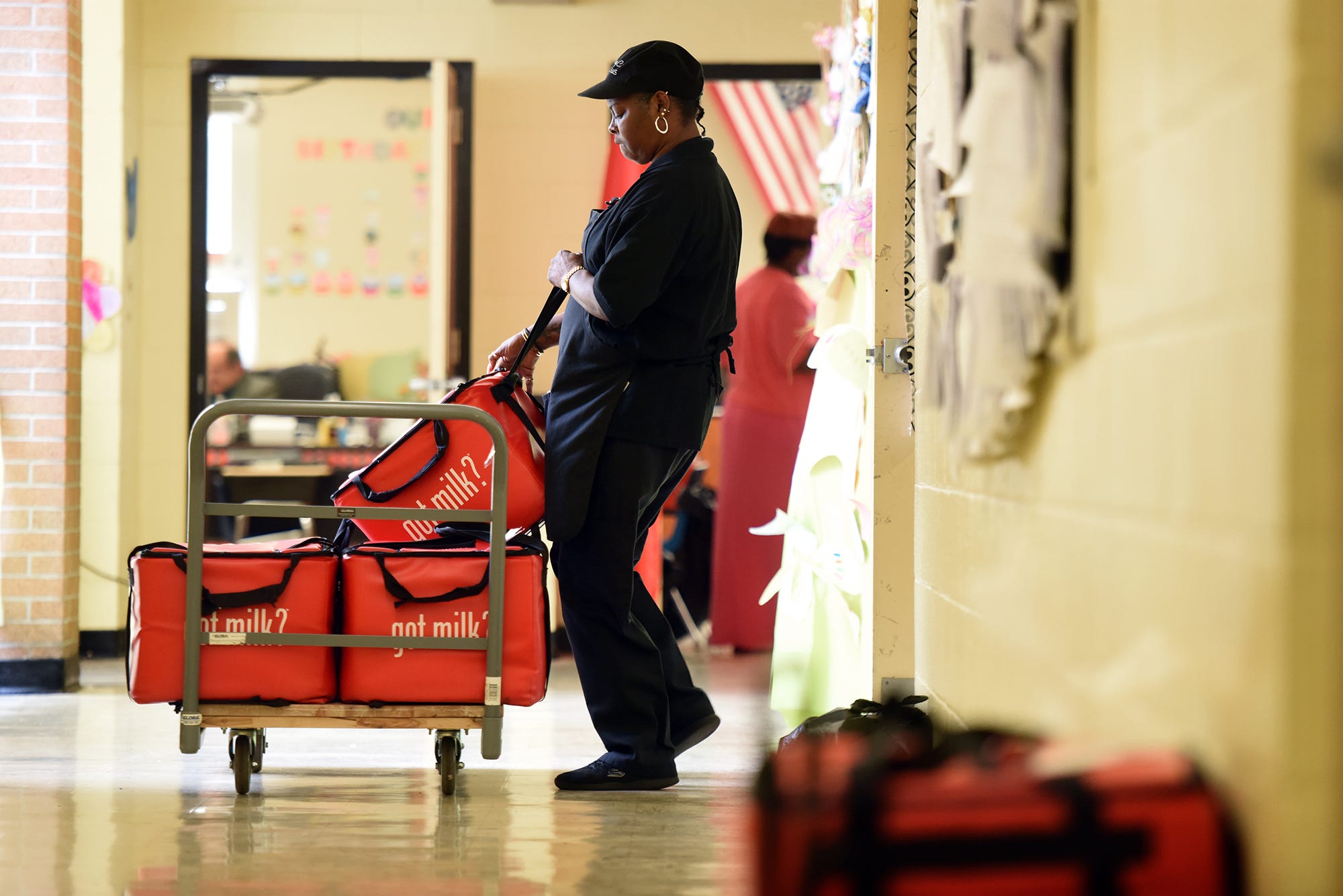
Lunch aide Sandra Palms picks up the breakfast bags and garbage from 15 classrooms after breakfast at Dr. Martin Luther King Jr. School #11 in Jersey City.
In Jersey City, some building leaders were sold on the idea at the outset, but others were concerned about the logistical challenges, said Superintendent Marcia V. Lyles. What would serving a meal at the start of the school day mean in terms of lost instructional time and expanded clean-up duties?
“At the end of the day, I just had to mandate it,” she said. “We are always having a conversation about what we can and cannot control. We can’t control poverty, that’s true. But when we have an opportunity to mitigate those factors, like serving breakfast, which is so important — the question is, why aren’t we doing that?”
Serving breakfast after the bell “isn’t really that hard,” she said. “And the principals and the people in the schools really recognized its importance. This, for me, is like preschool and other readiness programs. We are addressing our equity issues and making sure kids come to school ready to learn.”
That is a driving interest at P.S. 11, said Assistant Principal Mary K. Truesdale. “There are some children who would not have gotten any breakfast without this.”
Being ready to learn is important — but there’s a coziness factor too. Getting together in the morning to share a common meal before a long school day is, well, nice.
“They come and interact a little,” said teacher Kristin Haviland. “It’s a good way to practice their manners and having a quiet conversation.”
Her student Grace Santos, 8, agreed.
“We eat, and sometimes we talk a little,” she said. “But when we’re done eating, we can go straight on to our next thing, and we have energy to do more things in our day.”
 
 
Bright is made possible by funding from the Bill & Melinda Gates Foundation. Bright retains editorial independence. The Creative Commons license applies only to the text of this article. All rights are reserved in the images. If you’d like to reproduce this on your site for noncommercial purposes, please contact us. Follow us on Facebook and Twitter.

124 Days


Columbia Road and 18th Street
I wrote this essay for the Recovery Cafe open mic at the wonderful Potter’s House in Washington, DC. Recovery communities, musicians, artists, supporters, families, and friends are all invited to express themselves at the Recovery Cafe community as they find their way.
One day when I was 16 years old I was playing around on my family’s computer — doing something very dorky probably — when my mom stormed in and put a garbage bag at my feet and said “I think you have something in your closet you need to clean up.”
I knew what she was referring to and unlike most teen boys, it wasn’t porn. Because when I was 16 porn frightened me. What had happened was my mom had found the dozen or so empty bottles of vodka I’d hoarded in my closet because I was too nervous to smuggle them out of the house. After a few seconds I broke the silence between my mom and me and said, quote “Can we please talk about this situation like adults.” I literally said this. A sixteen-year-old. To his mother. My mom said, “Yeah. Sure.”
I said, “I just want you to know, it’s not like I’m having friends over and partying or anything. I just drink the vodka alone.” This is a sentence I actually said to try to comfort my mother. My mom said “That doesn’t make me feel any better.” I said, “I’m just getting all of the drinking out of my system now so when I go to college, I can focus on getting good grades.” My mom said, “It doesn’t work like that.” I’m 33 years old now and I can tell you beyond a shadow of a doubt that, as she was with most things, my mother was correct. You don’t get alcoholism out of your system by drinking a ton of booze when you’re 16 years old. In fact, alcoholism is the kind of thing that follows you everywhere.
My name is Chris. I’m 124 days sober today. In the 17 years since I began abusing alcohol in isolation, this beats my previous streak of sobriety by about 120 days, so it’s something.
The most helpful way I heard addiction explained was in rehab. The brain is hardwired to know that it needs water, air, shelter — basic necessities to survive. Addiction is your brain getting tricked into thinking it needs something more. My brain thinks it needs alcohol just to survive. It thinks it needs an obscene amount of alcohol every night just to be able to fall asleep. I did this for 17 years, with very few reprieves. At some point during that, I forgot how to fall asleep sober. When I began detox, I literally did not know how to fall asleep sober. I had to learn how to do that. And the thing about that? It was hell.
I had a major problem that I hid from literally every single person in my life. I don’t get drunk and out of control in front of other people, I get very drunk alone. And then I hide it very well. I drink to escape myself. To escape the world. My tolerance to alcohol has built up quite a bit over the last 17 years. I drank a lot. At the beginning of this year I began drinking even more than usual and this triggered a severe depressive episode and on a couple especially bad nights, I came close to jumping off the Taft Bridge. That’s what happened. If you live in the area you know the Taft Bridge and the Duke Ellington Bridge form a V-shape over Rock Creek Park and the Duke Ellington Bridge has suicide barriers and the Taft Bridge does not and in January and February I was drinking most of a bottle of wine and a pint of vodka every single night, and I got in the bad habit of walking across the Taft Bridge at night, every single night. I didn’t know how to stop. I hid it from everyone. And it almost killed me.
My brain believes it needs alcohol. Just to survive. Just to interact with people and feel like a normal person when I do it. Just to not be depressed and anxious and scared all the time. Just to be able to fall asleep, even if it means waking up still buzzed and counting down the minutes until my next drink, barely aware I’m even doing it. That’s the disease. My addiction is such that alcohol is where I spent half my life finding my sense of self-worth, my sense of confidence and hope and belonging to the world. And now that’s gone. I was happy living in this state of blissful detachment all of the time and alcohol served me very well, until it very much did not. So now I’m trying to rebuild and find happiness elsewhere.
Today, my 124th day of sobriety, was hot. And I work on a farm. And on days like this my brain gets preoccupied thinking about picking up a cold six-pack on the way home, so much so that I can hardly think of anything else. And my brain plays tricks on me. It says, “You’re not really an alcoholic. You remember how good beer is. It’s just one six-pack.” (Like “just one six-pack” should even be a thing.) So then I have to start an argument with my brain. “No, I AM an alcoholic. No, I CAN’T have just one beer. My brain doesn’t work like that. And I remember how bad things were just a few months ago. And the truth is, the next time I drink might be the last thing I ever do.”
So tomorrow I’ll be 125 days sober. On Monday I’ll be 126 days sober. And so on. I count the days like this, because my life depends on celebrating each day of sobriety and not waking up horribly anxious and scared and hungover. Because thinking about a lifetime of sobriety is overwhelming to the point of being completely counterproductive and harmful. Tuesday, 127 days. Wednesday, 128 days. I celebrate each day. While my brain stabilizes and my emotions find their footing, I cherish each day. Even the very hard days, and there have been plenty of those in the last four months. Thursday, 129 days. Soon, 5 months. Then 6 months. That’s half a year. Then, before I know it I’ll be able to say I’ve been sober for a year. To the universe that’s nothing. To me, it’s an eternity. So I count each day, even the hard days, especially the hard days. And I’m grateful for all of them.

Sunday, 11 June 2017

Sometimes life forces you to calm down - DJ Cuppy says as she moves back into her parents' house

Billionaire Femi Otedola's daughter and famous disk jockey, DJ Cuppy has moved back into her parent's home.

  Florence Ifeoluwa Otedola, aka DJ Cuppy has moved back into her father's house. She took photos from her parent's home and revealed she is back in their house due to a situation which she did not go into detail about. She said: "People have been as king me where I moved and why, lol.

So, I moved back in with my parents and while this wasn't what I really wanted, sometimes life forces you to calm down. We occasionally need to take one step back to allow two steps forward."

  This news is coming months after she received a car from her boyfriend, professional footballer Victor Anichebe is a professional footballer . Fans are wondering if their relationship was the reason she decided to no longer live on her own. It seems only time will tell.

Friday, 9 June 2017

How to Make Lifelong Learning a Daily Habit

Anyone who stops learning is old, whether at 20 or at 80. The greatest thing in life is to keep your mind young. — Henry Ford
Many of us still operate under the idea that, once we leave school with our diplomas in hand, there’s no need to continue mastering different areas of knowledge. However, the reality is that we no longer live in a world where learning can stay fixed for anyone in any trade. Adaptation is a currency worth its weight in gold in today’s business world, where new innovations are continuously changing the game.
It’ll not only allow you to survive in this changing entrepreneurial landscape but to thrive in it. Being a constant learner means staying sharp, relevant in your field, and ahead of the curve. And forming these habits doesn’t have to be difficult or terribly time consuming either.
Without further ado, here are 3 smart ways to make lifelong learning a daily habit:

Set specific and concrete learning goals

First things first, get those self-improvement ideas out of your head and out into the real world in a tangible way. Writing a list of what you want to learn can help you stick to your goals in a meaningful way.
Next, create objectives that are manageable, by breaking down big picture goals into daily, monthly, and annual stepping stones. If you want to learn more about SEO techniques, for example, you could set a goal to read one blog post about your area of interest per day. Chrome extensions like Prioritab can also help you keep your short-term daily goals and long-term weekly and monthly goals in sight.

You don’t need a classroom to learn

The internet has given us many amazing things — including access to top-notch online courses — that allow us to learn nearly any topic under the sun.
While more traditional methods of learning, like being in a physical classroom, will always be indispensable, the internet is also an invaluable tool, when setting out on your journey as a lifelong learner. It can broaden your horizons and allow you to tailor learning to your daily schedule and needs.
You can even get an Ivy League education for free from Open Yale Courses and Stanford Online, which are filled with hundreds of video courses on everything from financing to psychology.
Other fantastic learning resources include sites like Lynda.com and Coursera, which are effective and affordable education companies that let you search for specific online classes and complete them at your own pace. With these sites, you can learn how to build an Android app, or learn Photoshop, or SEO marketing techniques, just to name a few options.
Another great, free education tool is YouTube, which is populated with tutorials on just about anything you could think of. Not to mention, you can use it to catch up on cutting edge TED Talks and stay current on new developments and ideas.

Learn during your downtime

As a busy businessperson, it can be hard to squeeze in time for continued education. However, with podcasts and nonfiction audiobooks, that task is much more attainable. A perfect time to dive into audio learning is during your commute to and from work, or while you exercise, or cook. If you’re looking for a good place to start, The Harvard Business Review’s podcast, HBR Ideacast, is excellent for anyone looking to sharpen their entrepreneurial skills and learn from the leading minds in business.

Final thoughts

Making learning a lifelong a daily endeavor might sound like quite the time investment, but it’s one that will pay off in the future and can be done in bite sized increments every day. So get started today — your future self will thank you.

Successful People Are Not Necessarily Smarter. They Just Do More Of This

This is how you build world-class expertise in any field.


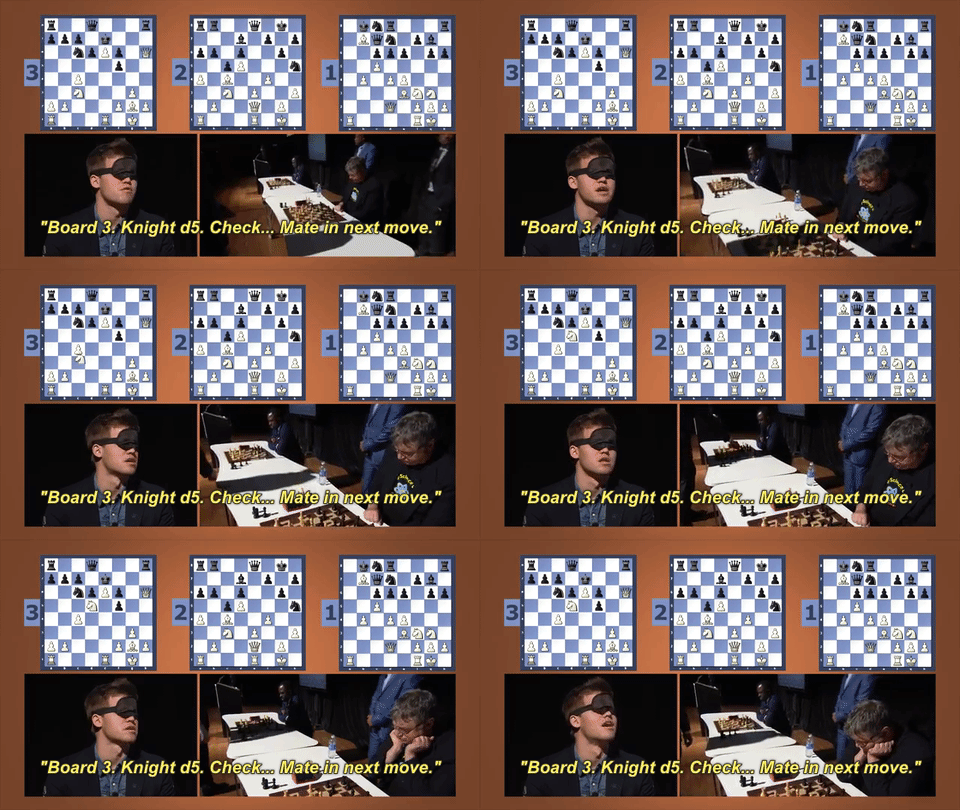
You’re playing speed chess… with a blindfold… with multiple games going at once.
At the 2015 Sohn conference, the highest-ranked chess player in history, Magnus Carlsen, did exactly this, and it’s a feat to behold.
Carlsen quickly makes his moves (navigating 60,000+ possible chess moves in his mind) while his opponents flounder.
Source: Magnus Carlsen Blind & Timed Chess Simul at the Sohn Conference in NYC
Carlsen’s first win is a checkmate. His second is a resignation. The final opponent loses on time!
If you’re like me, when you see feats like this, you wonder:
How can I perform like this in my own field?

This article answers that question.
You can use the same principle that Carlsen uses to master chess, to master your field and become more successful.
How is that possible? The short answer is chunking. Professor Barbara Oakley, co-instructor of Learning How To Learn — the largest course in the entire world in any subject — has this to say about chunking: “I’m becoming increasingly convinced that ‘chunking’ is the mother of all learning — or at least the fairy godmother… Creating neural patterns — ‘neural chunks’ — underpins the development of all expertise.”
Experts like Carlsen learn how to harness this power through thousands of hours of deliberate practice.
Here’s the full breakdown on why chunking is one of the most important parts to becoming a world-class expert.
Explainer: How Chunking Happens
Think about when you first started learning to read (or when you see a child learning to read). Although you didn’t realize it, you were chunking!
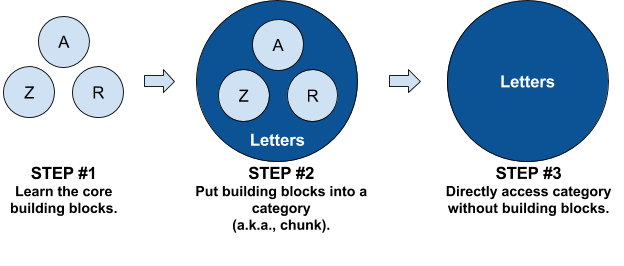
The first phase was learning that these random shapes you were seeing were actually a new concept called letters. You combined multiple things into one new thing. That is the essence of chunking. In this case, you combined shapes into a new chunk called letters.
As you developed mastery of letters, you learned that they could be combined into a new concept called words and that these words could be accessed automatically.

Over time, you continued additional levels of chunks. You realized that words could form word groups, which could form clauses, which could form sentences, which could ultimately form stories.
And voila! You suddenly had a new magical ability: the ability to read. You no longer had to sound out each letter. Where there used to be randomness, you now saw order.
When you build more and more complex chunks upon chunks, you gain new abilities. The only reason that reading isn’t considered magical is because so many people can do it. World-class experts, on the other hand, follow the same process, but they just focus on areas of expertise that few other people have mastered and they spend more time in the mastery process.
How Magnus Carlsen Chunks
This takes us back to Magnus Carlsen and his no-longer-magical ability to play blindfolded speed chess.
Carlsen isn’t memorizing each individual piece on each individual square on each chessboard, which would mean memorizing millions of possibilities. That would be truly magical. Instead, he’s using an ability that we all have: the ability to form and use complex chunks. Through years of deliberate practice and chunking, Carlsen:
  • Has memorized tens of thousands of complex chunks: still a large number, but much more tenable!
  • Is able to automatically and rapidly access those chunks through his intuition.
This explains why he can move fast while his opponents are brooding over where to move next. They haven’t built up enough chunks yet, so they need to consciously examine each possible move and go through all of the implications.
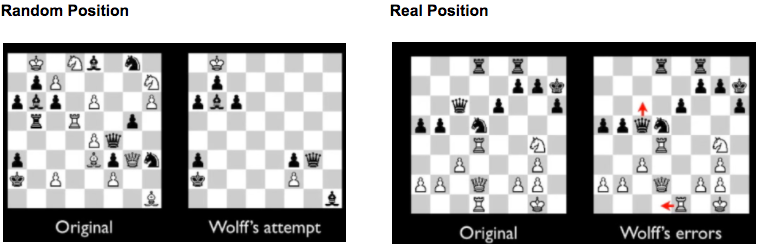
Just how important chunking is was discovered in a landmark study. The researchers had novice and expert participants view a chess position for a few seconds and then reconstruct it from memory.
In the first experiment, the position was one that could appear in a real game, and experts far outperformed novices. In the second experiment, the chessboard was arranged randomly in a way that would never happen in a real game. The grandmasters immediately lost their edge. They could no longer use their saved chunks.
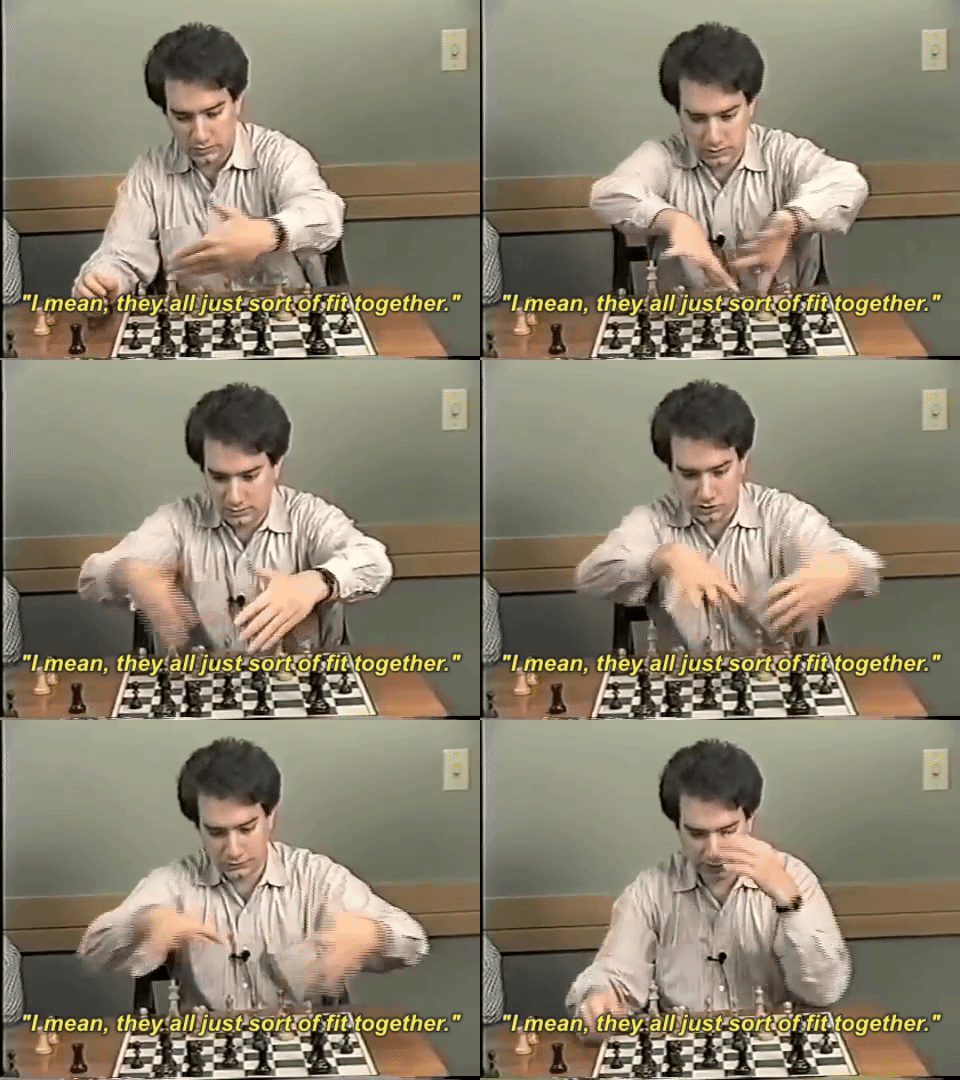
More recently, researcher Daniel Simons replicated the experiment with chess grandmaster Patrick Wolff and posted it on Youtube. Wolff’s attempt in the random position is almost pathetic. In the real position, it is a miracle. Only two pieces are misplaced, and they’re only misplaced by one square.
Also, notice how Wolff describes the feeling when he’s chunking. Rather than describing the process of working with chunks as difficult, mechanical, or deliberate, he describes it as flowing and unconscious. This is a hallmark of mastery.
Chess grandmaster Josh Waitzkin further unpacks what this process feels like in his seminal book, The Art Of Learning:
… over time the intuition learns to integrate more and more principles into a sense of flow. Eventually the foundation is so deeply internalized that it is no longer consciously considered, but is lived.
He later adds…
[A] great pianist or violinist does not think about individual notes, but hits them all perfectly in a virtuoso performance. In fact, thinking about a ‘C’ while playing Beethoven’s 5th Symphony could be a real hitch because the flow might be lost.
What It Means For Us: Why Mastery Takes So Long
Learning the concept of chunking is both exhilarating and disheartening.
It’s exhilarating because it shows us how we can develop superpowers in our field if we stay committed. With just one building block at a time, we become an expert over time.
It’s disheartening because it shows us why building world-class expertise is a process that takes thousands of hours of practice in most fields. Just like a pyramid is built with individual bricks, starting from the foundation and moving up, so too is our expertise. Every chunk is one brick.
In order to learn a single chunk, we must:
  • Understand what its building blocks are.
  • Understand how they connect into a new concept.
  • Practice using the concept so much that it becomes automatic.
Sure, it’s possible to increase the speed at which we build our mental pyramids. Also, some people are hardwired to learn these chunks faster. But either way, if we bypass the process and don’t build a strong foundation, the overall pyramid becomes weaker.
How To Build Chunks In Your Daily Life With The 5-Hour Rule
Dedicating time to chunking is not as hard as it sounds. Simply setting an hour aside per day for deliberate learning compounds over time. I call this the 5-hour rule, and I learned it by observing the deliberate learning rituals of some of the world’s top entrepreneurs.
I may never attain the level of performance of a true prodigy like Carlsen, but because I am building up chunks of expertise every day, I’m able to see my performance constantly improve. Maybe one day, I will be a grandmaster in my field. This is potential that chunking gives us all.
Interested in creating a learning ritual in your life?
I created a free learning how to learn webinar you might like. It’s based on the learning best practices of the world’s top entrepreneurs and performers.
***

Archaeologists unearth the oldest Homo sapiens ever discovered


The 300,000-year-old fossils discovered in Morocco had modern faces and more primitive brains

 
This virtual reconstruction is a composite of CT scans taken of multiple fossils discovered at Jebel Irhoud, Morocco. The features are human-like, but the shape of the brain case is more primitive.
Video by Philipp Gunz, MPI EVA Leipzig

Archaeologists have unearthed 300,000-year-old fossilized bones of early humans — the oldest remains of Homo sapiens yet discovered, two new studies report. The ancient bones contain a mix of modern and primitive features that hint at an early, and previously unknown, phase of our species’s evolution.
On the family tree of human relatives, collectively known as hominins, our ancestors split from the Neanderthal branch more than 500,000 years ago. Fossils that looked like modern humans started showing up in East Africa about 200,000 years ago. But when exactly modern humans evolved from our most recent ancestor, probably Homo heidelbergensis, is a mystery. Now, two new studies published today in the journal Nature fill in some of those missing millennia, and suggest that hominins were well on their way to looking like modern-day humans about 300,000 years ago.
This lower jawbone is nearly intact, and it contains a mix of primitive and modern features.
Photograph by Jean-Jacques Hublin/MPI-EVA, Leipzig
The fossils come from an archaeological site in Morocco, called Jebel Irhoud. Hominin bones were first pulled out of the ground there in the 1960s, and were dated to about 40,000 years ago. But the archaeologists were sloppy, and experts began to suspect that date was very wrong. So, in 2004, the site reopened and over the next seven years, archaeologists unearthed more hominin remains, including parts of skulls and jaw bones. They also found animal bones that had been butchered and possibly cooked, and stone tools that had been burned at some point — all in the same layer of dirt. That’s key: being in the same layer means these finds were all approximately the same age.
The stone tools were a lucky find, because they gave the researchers — led by Jean-Jacques Hublin and Shannon McPherron at the Max Planck Institute in Germany — a chance to date that layer precisely. By measuring how many electrons accumulated in the tools over millennia, the researchers dated the layer and the hominin bones within it to about 315,000 years ago.
These burnt stone tools gave the researchers a way to date the layer containing the hominin remains.
Photograph by Mohammed Kamal/MPI EVA Leipzig
From the skull fragments, the researchers virtually reconstructed the faces of the ancient humans who had once lived at the site. Their features were small, and their faces were tucked underneath the brain case, rather than jutting out in front. “The face is the face of somebody you could cross in the metro,” Hublin told Michael Greshko in National Geographic. But the brain case was more primitive — flatter and longer instead of high and round, like ours. That’s why Hublin and his colleagues think the ancient denizens of Jebel Irhoud were an early evolutionary phase of Homo sapiens — somewhere on the developmental path between Homo heidelbergensis and us.
The two authors of an analysis published alongside the study agree with this assessment. But, the findings haven’t been met with universal approval. Paleoanthropologist John Hawks at the University of Wisconsin-Madison told Greshko that these new studies “really aren’t adding anything new except the date.” Hawks added that he doesn’t think the findings warrant creating a new category of “early modern humans” to describe the mix of primitive and modern traits. But regardless of what we call these ancient relatives of ours, these new findings give us a better idea of how we became who we are today.

Wednesday, 7 June 2017

My life is focused on learning new information


I will never let myself graduate

Lately I have become completely obsessed with learning new things.
I’ve always believed that the path to a happy and successful life, is to always be learning new things, to always be learning new skills, to never let yourself graduate.
I apply that in my daily life, by learning something new every single week. I push myself to take new courses.
I push myself to learn new skills. I push myself to do new things. Every day, and every week, I sit down and I write my answer to this simple question. What have I learned?
It’s not all about self improvement, and it’s not all about chasing some idea of success, sometimes it’s just about learning something exciting, or interesting, or something that can expand my own mind.
The thing is, we have this incorrect idea that when we graduate high school or we graduate University, we can stop learning, unless it’s something that we are required to learn for our jobs.
Our lives actually depend on our ability to keep on learning. What makes me say that?
It’s the research that shows that people who stop learning, and who stop exercising their minds, and who stop pushing themselves and pushing their limits, are the ones who are depressed, who are open to alzheimers disease, and whose lives feel empty.
Human beings weren’t designed to just coast to the end of the road. Our minds are designed to be nurtured.
Our minds are designed to have new information input and new ideas output all the time. That’s what makes learning such a powerful exercise.
I don’t know why we try to stop learning, but it might have something to do with the impossible structure of so many of our learning institutions.
Maybe the joy of learning is shoved and squeezed right out of us in high school.
Maybe it happens in college. Maybe we just don’t think that it’s fun and there are louder, more colourful and more instant gratifications to focus on.
But I’m here to tell you that it’s not about how much you enjoyed learning to start with, it’s about how essential, and necessary, and vital it is for your ongoing happiness, that you continue to learn.

I hope I never reach a point where I stop learning. So I do a new course every week.

I hope I’m learning new things and having my ideas challenged for the rest of my life. That’s why I do a new online course every single week. And I really encourage you to do the same. It doesn’t have to be super complicated. It doesn’t have to be super challenging every time. It doesn’t have to take up hours. But it does have to be a course that you can start and finish every single week.
This week, I’ve been working through a course on wine making. Because I’ve always wanted to know more!
If you can do one free course every single week, can you imagine how much you learn in the 52 weeks you have this year? This is how you can supercharge yourself. This is how you can upgrade your skills. This is how you can improve your brain, improve your chances of success, and become a better person. It’s through the power of the land. You should never let yourself graduate. Not ever.


Sunday, 4 June 2017

After claiming to still be in 16-months engagement, Eva Alordiah announces her breakup with fiancé

Eva Alordiah shares details of regained singlehood

- Rapper and singer Eva Alordiah announced the end of her 16-month engagement to ex fiance

- Eva and Caesar got engaged over a year ago and broke it off after 16 months of wearing rings

- Just a few weeks back, Eva released a video denying their breakup

  Eva Alordiah finally announces her breakup to long time fiance, Caesar. Eva got the sweetest proposal from her beau at an awards show in Jan 2016 but released no wedding plans.

  Their engagement sparked a lot of comments from fans and most couldn't be more happy for the pretty singer. Their 16-months engagements started receiving negative comments when fans tagged her "lord of the rings."

  Eva shared the details of her singlehood on social media informing fans that she has left Caesar and this time it is for real. Recall that the singer released a video after rumour of their breakup surfaced online. She had denied it saying it was normal to be engaged that long and there was no rush.

  The multi-talented rapper who has a page dedicated to sharing posts about her love affair used the medium to announce the end of their eventful relationship. She wrote: "Singl e Again and not quite sure I was ready for the other side. Feels so familiar, this Single life, yet so new.I have been single for only 1 Day and I already feel My friends always used to Tease me and tell me I love 'Love'. I have finally accepted this is True. I do Love Love. What LEO Woman doesn't?

#ThatWasAReallyGoodMan and I may be silly to let him go but it's okay cause now #YouCanHaveHimSister! My head feels wobbly.I write a great deal don't I ?Maybe this happened so I can find a way to get back in my head and stroke the balls of my sleeping muse. I want a Cat.I have had dogs all my Life and they made for best of Friends those years I was Single. Should I get a Cat? I feel like If I finally do get a Cat it would be an all black one with Eyes that Gleam in the Darkness. Darkness: What lies in the wake of a Love never to be felt again. I want a Cat and I want to Write. No not Write Rap. Not that. It would be so wonderful to write a new Novel. I'd think about this in the coming days andblet you know what I decide.

  Hey don't feel sad for me. I let a Good man go, that must be a good thing no? I want to write a Novel. I have to write. I am going to Write. I need to Write. I am Writing. Don't Ask about me, I have gone to Write. I AM a Writer, First. 2:22 NEW"

The fattest woman manages to lose weight, but now husband isn't happy (photos, video)

- An obese woman managed to overcome her problem and lost two thirds of her weight
- Her husband was practically posing as caretaker while she was fat
- But now that she is independent, the marriage is
having trouble
  An extremely overweight woman from San Antonio Texas, who was featured in TLC’s My 600lb Life popular TV series, performed an amazing turnaround in her life. She lost 412 lb of her original 600 lb figure! Laura Perez’ transformation is complete. She looks like an entire new woman after undergoing gastric by pass surgery. But there is another not so cheery side to her weight loss story, and it involves her husband.
  Perez now admits her weight loss is threatening to destroy her marriage. Her husband, Joey, was always by her side at the worst moments she had to endure while she was obese.
He helped bathe her; and transport her, due to her extreme lack of mobility. In fact, she needed him for practically everything she did in life.
  Now, with a normal weight, and able to move around by herself, Laura does not depend on Joey anymore, and he now feels left out. Perez was featured on a special follow-up special episode of My 600Lb Life , called “Where Are They Now”. Her change in three years after she first got on the show was noticeably for the best.
  Joey had told on camera that Lara meant “the world to me. I love my wife a lot. It's hard to tell her no because I love her.” Now that his wife is independent, their relationship is about to break. Laura now feels that her body was not the only thing that needed healing and work, but also her marriage.
  They have confirmed their love for each other, but the dependence issue on behalf of Laura, apparently did affect Joey. They are presently undergoing counselling, and strive to make their marriage work.
Here is Laura during her TLC TV show:

Wizkid's baby mama Binta cries for prayers

- Wizkid's second baby mama, Binta Diamond begs fans to pray for her injured son

-The Guinean-American model shared photos of her son rapped in bandage

- Wizkid only just recently acknowledged Binta as his second baby mama

  Binta Diamond asked fans to pray for her little baby boy. Binta who is a Guinean-American model put to bed and gave birth to Ayo Jnr making her the second baby mama of the superstar, Wizkid.

  Binta who looked sorrowful in released photos with her son begged fans to pray for her son who she said got accidentally injured and it broke her heart. Binta is yet to state the nature of the injury but shared a photo of her little boy rapped in bandages.

  Ms Diamond explained that her world stopped when her son got accidentally injured. She said: "The hardest part of being a parent is that you cant stop the world from hurting your child, you can only be there to ease the pain #prayformyson ��" She further mentioned how it will hurt every mother to witness their child go through pain and begged everyone to pray for him.

RELIGIOUS TENSION: We don't want Christian workers again in our university - Katsina federal university Muslim students

Religious tension forces closure of federal university, Katsina

- Federal University in Dutsin-ma in Katsina state has been shut down

- The university was shut down over religious tension

- Muslim students accused the former Vice Chancellor, James Ayatse, of favoring Christians in filling academic and non-academic vacancies

Christians and Muslims are allegedly facing each other in what can be described as religious crises in Katsina. The alleged brewing tension between minority Christians and a larger body of Muslim students have resulted in the closure of the Federal University in Dutsin-ma in Katsina state by the university’s management according to Sahara Reporters.

  The crises started on Friday when Islamic students at the university mobilized and protested against Christian employees at the university. Andrew Moses, a security guard at the University, who spoke to Sahara Reporters said that: “We saw strange faces stationed at Academic Department housing the university management staff, including the Vice Chancellor. When we inquired about their mission, they simply said, ‘We are here for jihad against Christians in the university.’”While reacting to the incident, a lecturer at the university who asks not to be mentioned said that the crises has been a long standing one.

  According to him, it started when Muslim students accused the former Vice Chancellor, James Ayatse, of favoring Christians in filling academic and non-academic vacancies. He noted further that the boiling over of the crises was a result of a court order which recently reinstated Haruna Kaita.

  According to Sahara Reporter's source: “Professor Kaita came to the university with a group of Muslims who threatened to deal with any Christians working here,” referring to the Federal Government-owned university. He said further that Muslim students backing Mr. Kaita mobilized other Muslims groups from Dutsin-ma town to support their mission of sending the Christians away from the federal university. It was also gathered Samuel Zumve, the interim chairman of the Academic Staff Union of the Universities (ASUU), equally mobilized some Christian students who came together “prepared to defend their Christians fellows in the university.” Police officers have however been deployed around the university to forestall religious violence in the town and the university.
  Meanwhile, chairman of the university Senate, Bichi, has ordered immediate closure of the university until normalcy returns.